
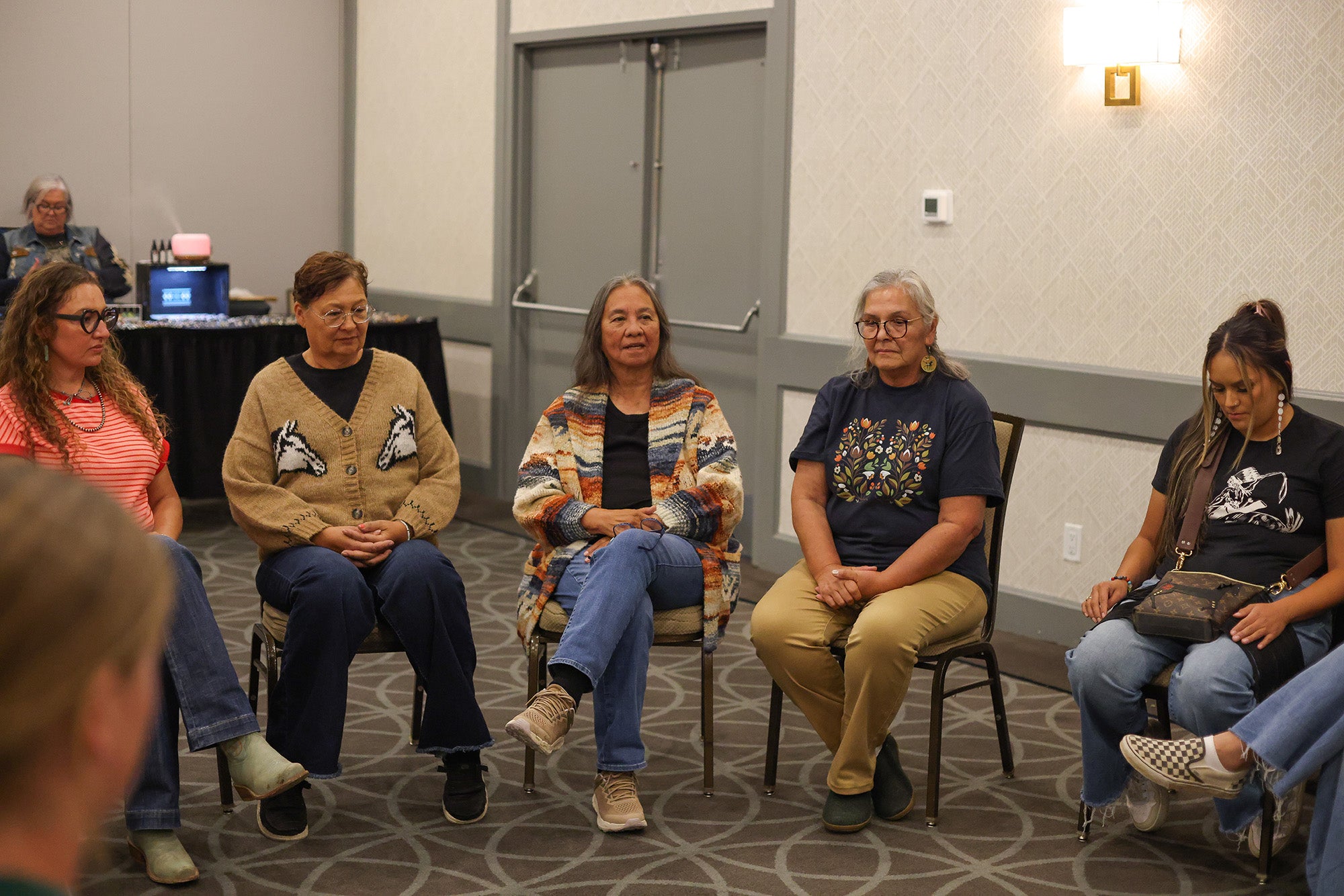
The Blackfeet Women in Ranching Gathering is a space for women to come together, learn, connect, and strengthen the skills that support our lives on the land.
This year’s gathering will focus on practical financial knowledge, Blackfeet sign language, and hands-on learning and creativity. Through financial sessions, cultural teachings, and time spent creating together, participants will leave with tools they can use in their everyday lives and in their ranching operations.
More than anything, this gathering is about connection. It is a place to share knowledge, learn from one another, build relationships, and continue strengthening a community of Blackfeet women who support one another.
Come as you are, bring your experiences, and spend the day learning, creating, and connecting.

Daily Agenda
Join us for a weekend created for Blackfeet/Blackfoot women to come together, learn, reconnect, and enjoy time in community. This year’s gathering will include practical financial sessions, Blackfeet sign language, cultural storytelling, hands-on creativity, and plenty of time to visit and build relationships with one another.
See tabs below for a breakdown of daily schedule.
Friday October 2nd, 2026
3pm - Hotel Check In
Saturday October 3rd, 2026 | 8:30 AM – 4:00 PM
8am - Breakfast available
8:30 – 9:00 AM - Welcome, Introductions, Prayer, Community Agreements
9:00 – 9:30 AM - Blackfeet Craft Session: Create + Connect - Tiffany St.Goddard
A relaxed, hands-on session to slow down, visit, and create alongside one another. This time is meant to give women space to connect, enjoy the creative process, and make something meaningful to take home. No experience needed, just come as you are and enjoy the time together.
9:30 – 11:00 AM - Financial Session Part 1- Caroline Wild
Making Your Financials Work for You: We become ranchers to steward the land and livestock, to spend time with our family, and to get outside, not to sit behind a computer and go over our financial records! However, by employing a couple of practices, we can help both our current and our future selves have an easier time opening the financial software (or notepad). This session will cover the split between personal and ranch finances, what information is necessary for operation loans or cattle purchase loans, and what is important to track for taxes. This session will lay the foundation for the afternoon session about enterprises and profitability.
11:00 – 11:15 AM
Break
11:15 AM – 12:00 PM - Blackfeet Sign Language Part 1- Valerie Heptner
A hands-on session introducing Blackfeet Sign Language through cultural teaching and shared learning. Participants will learn signs, their meanings, and the importance of keeping this knowledge alive and passing it on to future generations.
12:00 – 1:00 PM
Lunch
1:00 – 2:00 PM
Blackfeet Sign Language Continued- Valerie Heptner
2:00 – 2:15 PM
Break / Transition
2:15 – 3:45 PM Financial Session #2- Caroline Wild
Enterprise Profitability: What Is Making You Money? Ranches are unique business models because there are often multiple income generating-opportunities occurring at once. This can make targeting profitability difficult and can make decisions about expansion hard to figure out. This session will start with an overview of overhead costs versus cost of goods sold, look at enterprises and then dive into analysis!
3:45 – 4:00 PM
Final Questions & Saturday Wrap-Up
Sunday October 4th, 2026 | 8:30AM – 11:30 AM
8am - Breakfast available
8:30am - Morning prayer and Tea Bar
9:00am – 10:30am
Elder Storytelling- Carol Murray
A time to listen, learn, and connect through stories and teachings shared by a Blackfeet elder. This session is a reminder that our stories matter. Don’t be afraid to share your stories, experiences, and knowledge with others, they are part of how we stay connected, learn from one another, and carry teachings forward.
10:30 – 11:30am
Closing Circle & Reflections- Tiffany St.Goddard
A time to come back together, reflect on our time shared, and close the gathering in a good way. Participants are invited to share what stood out, what they will take home with them, and any final thoughts or stories they would like to leave with the group.
Event Registration
Registration is tiered and ranges from $100 to $300 per person and includes all gathering sessions, materials, and meals provided throughout the weekend.
We never want cost to be the reason someone cannot join us. Scholarships are available for participants who need financial assistance. If the registration fee is a barrier, please select the scholarship option during registration. No lengthy explanation is required.
Space is limited, and advance registration is required.
Come as you are. Bring your stories, your questions, and your willingness to learn and share. We’re excited to gather across the Medicine Line again and continue building our community together.
-
Emerging Rancher: $100
Choose this tier if you are a beginning but active rancher or farmer (defined by USDA as 10 years or less of management experience) and have limited financial resources but still wish to actively support the event and our community’s mission. This tier covers the cost of your attendance and helps keep the event sustainable. By selecting this tier, you’re demonstrating a commitment to our shared community values and supporting accessible, impactful programming.
-
Steward of the Land: $200
Choose this tier if you are building your business, lease land without full stability, and/or are in the early years of paying for your land, but you have a sound bank relationship and are food secure. By selecting this tier, you are demonstrating a commitment to paying our leaders and speakers their full value as presenters.
-
Community Champion: $300
Choose this tier if your business is well established and you have stable access to land, financial resources, and food security. Your contribution at this level helps sponsor lower-tier tickets and offsets operational costs, allowing more women ranchers to join who might otherwise be unable to afford a ticket. By selecting this tier, you are empowering a more diverse and inclusive gathering by ensuring that people with varied economic backgrounds can attend.
-
Scholarship Ticket
scholarship FormWe offer a limited number of community-supported tickets to make this accessible to all. These tickets reflect our belief that everyone has something valuable to contribute, and that cost should not be a barrier to connection, learning or leadership. If you wish to complete a scholarship application, please check that option on the application form and fill out required questions.
Get to Know Your Facilitators, Speakers, and Presenters
-

Tiffany St.Goddard
-

Caroline Wild
-

Carol Murray
-

Valerie Heptner
-

Mariah Gladstone


Tiffany, her husband, and two daughters raise cattle and horses on the Rocky Mountain front. Deeply rooted in ranching, Blackfeet culture, and a love for horses, she finds fulfillment in raising her children in this way of life.
Tiffany holds a bachelor's degree in Business Administration and an associate degree in Equine Management, bringing a wealth of experience to her various roles. After spending 10 years as a school district Business Manager, she now embraces her life as a full-time ranch and rodeo wife, sports and 4-H mom, business owner and part-time consultant.
In addition, Tiffany serves as President of Sapoo Horsemanship, a newly established non-profit, and owns Deep Creek Feeds, a small, family-run livestock mineral business. She enjoys colt starting with her husband and the peaceful hours spent at the barn as a family.
Tiffany is the program lead of Women in Ranching's "Rooted in the Land" program, which was created by Indigenous women for Indigenous women. She has cultivated the Spirit of the Horse Camp. An annual youth girls leadership, horsemanship and Blackfeet Culture camp held each July since 2024. Passionate about her community, she serves as an ambassador for agriculture, women of the land, and the Blackfeet Nation.
Caroline brings years of experience facilitating Women in Ranching’s Virtual Ranch Management series, as well as running WIR’s Leading With Numbers financial management cohort. Through that work, as well as her personal business: Wild Ranch Solutions, Caroline has developed a deep, hands-on understanding of the challenges and opportunities facing women in ranching. She brings a thoughtful, grounded approach to helping individuals clarify their vision, commit to meaningful goals, and move toward them with purpose and support. Caroline has a bachelor’s degree in Livestock Management and Industry from Montana State University and a Master’s in Ranch Management from the King Ranch Institute for Ranch Management. From running the DNA department at the American Simmental Association to organizing pens of cattle at Headwaters Livestock Auction, Caroline learned to love problem-solving on the go. She has baled hay and fixed fences from north of Yellowstone up to the plains and breaks of Central Montana and served as a Ranch Systems Analyst for a large ranch in northern Wyoming and southern Montana. Based in Wyoming, Caroline takes on the world with her dog, Moxie, a frequent participant in her adventures, whether road-tripping obscene distances, hiking to alpine lakes, or devouring a book on the front porch.
Carol is from Badger Creek near Browning and now lives along the Two Medicine River on the Blackfeet Indian Reservation. She has dedicated her life to preserving and revitalizing Native American culture, especially for her people, the Amskapii Piikanii (Blackfeet Nation).
She earned her degrees from Blackfeet Community College and Montana State University, working for 36 years at Blackfeet Community College in various leadership roles. Carol now serves as a tribal adviser for the Blackfoot Gallery at the Glenbow Museum in Calgary and has co-curated for the Smithsonian Institution.
Valerie “Val” Running Fisher-Heptner was born September 11, 1962, on the Blackfeet Reservation in Browning, Montana. She has built her life and raised her family rooted in ranching traditions and community. From a young age, Val was immersed in a family who used Sign Talk, also known as American Plains Indian Sign Language, a tradition that shaped her understanding of communication and culture. Together with her husband, she owns and operates a cow-calf operation, caring for livestock with dedication and respect for the land. Her story weaves together heritage, hard work, and the enduring role of women in agriculture, offering a powerful perspective on tradition and resilience.
Mariah Gladstone, Piikuni (Blackfeet) and Tsalagi (Cherokee), grew up in Northwest Montana on and near the Blackfeet Reservation. She graduated from Columbia University with a degree in Environmental Engineering and returned home where she began her work on food advocacy. She developed Indigikitchen, an online cooking platform, to revitalize and re-imagine Native foods. Along with her husband Casey, she raises grass-fed beef at MyTFine Ranch and operates a campground in East Glacier. When she's not busy harvesting, hunting, cooking, or ranching, she spends time behind her camera capturing the strength and beauty of the people and mountains.


